~ Saving Private Sheridan ~
By Daniel A. Sheridan
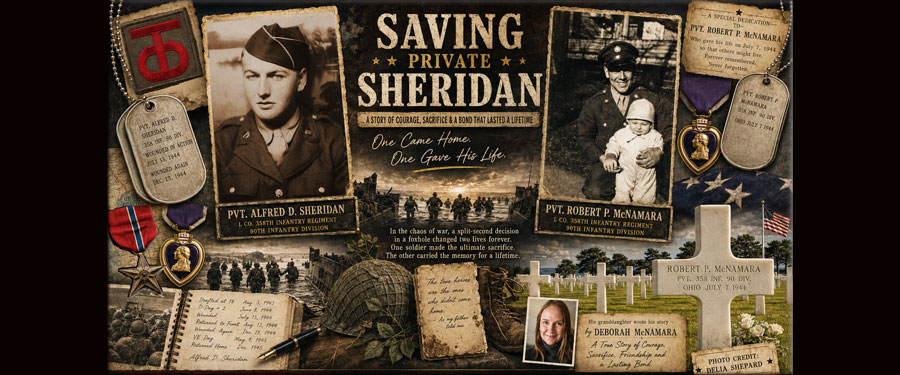
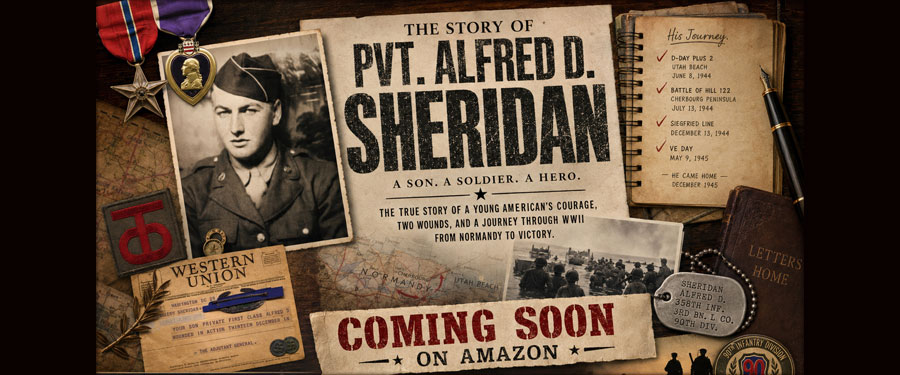
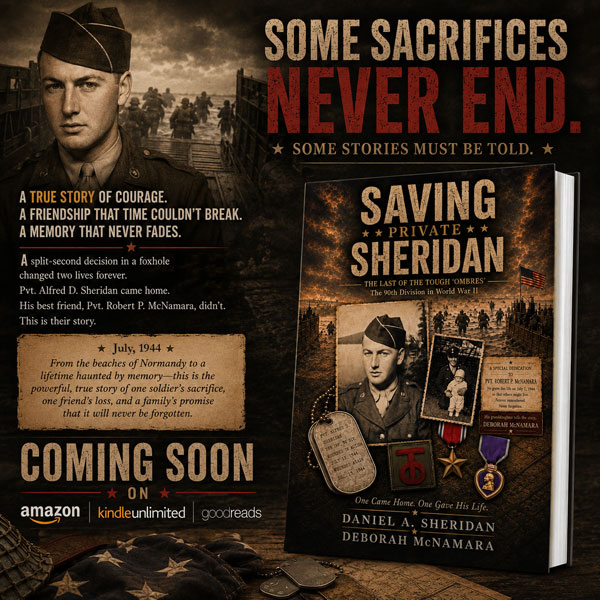
My father, Alfred D. Sheridan, was drafted at the age of 18 on August 3rd, 1943 and went on to serve in L Company, Third Battalion, 358th Infantry of the 90th Division. His division landed on Utah Beach in Normandy on D-Day Plus 2 (June 8th, 1944). He was wounded at the Battle of Hill 122 on the Cherbourg Peninsula on July 13th, 1944. He received a Purple Heart and a Bronze Star Medal for "Meritorious Achievement in Ground Operations Against The Enemy on or about July 13th, 1944" and returned to the front on August 13th, 1944.
The 90th Division slowly made it's way across France towards the border with Germany crossing the Moselle River in November 1944. He was again wounded on another 13th - December 13th, 1944 during fighting along the Siegfried Line - the heavily fortified German line of defense along its border with France. He described being shot in the right arm like being hit with a sledgehammer. When he could no longer write letters home with his right hand, his mother joked that she could finally read his handwriting - left handed and all.
When he returned to the front for the second time, my dad thought his number was up and did not look forward as the 13th of another month approached. The War in Europe ended on his birthday - May 9th, 1945 - VE Day. His division then made preparations to be transferred to the Pacific to fight the Japanese, but the war ended in August 1945 and he eventually returned home to the Bronx in December 1945.
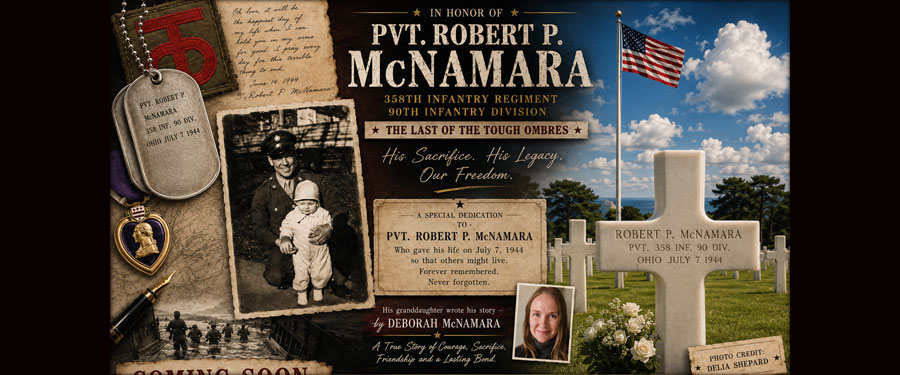
A Tribute To Pvt. Robert P. McNamara Of The 90th Infantry Division
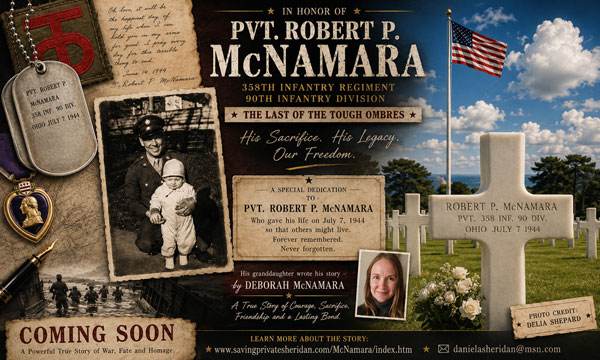
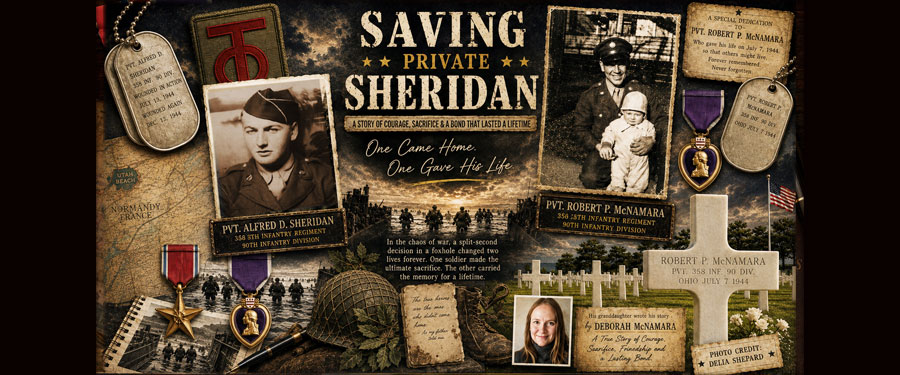
This website is dedicated to Pvt. Robert P. McNamara, and to the veterans of the 90th Infantry Division who fought in World War II. The red T-O of the division patch originally stood for Texas-Oklahoma, but the 90th soon became known as the Tough 'Ombres.
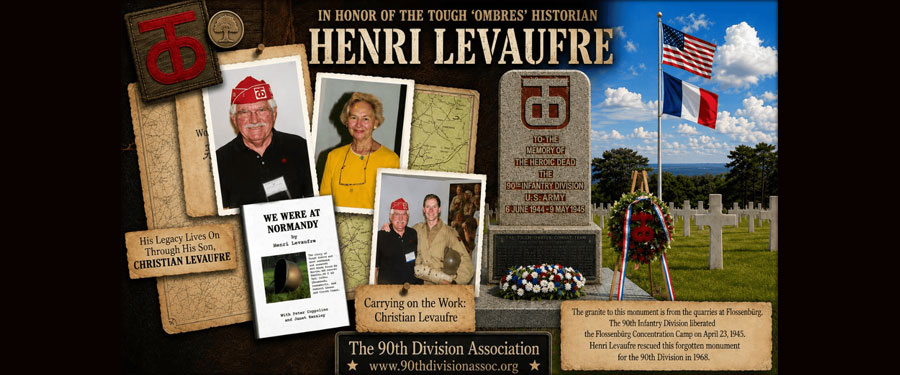
A Tribute To Henri Levaufre & The 90th Division Association
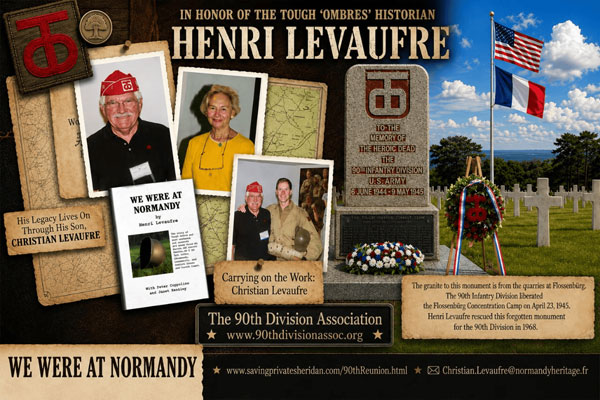
Back in 1968, Henri Levaufre helped rescue the 90th Division Monument, according to an article by Amelia Abney, The 90th ID at Utah Beach, In Memory of ‘Patton’s Favorite’Division.
At the end of the War, soldiers from the 90th Infantry Division chipped in together to have a monument dedicated to their fallen comrades. At the time, they were stationed in Weiden, Germany, after V-E Day on May 9, 1945.
— The granite for the “stele” came from the quarries at Flossenbürg.
— The 90th Infantry Division liberated the Flossenbürg Concentration Camp on April 23, 1945.
[A "stele" is a tall, upright stone slab used in the ancient world as a monument, grave marker, or boundary sign.]
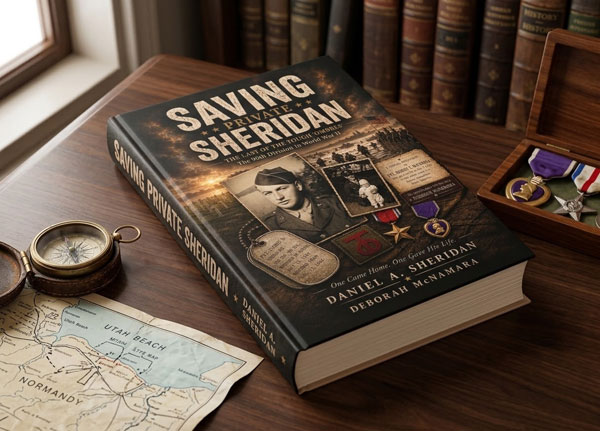
Click here view book trailer on YouTube.
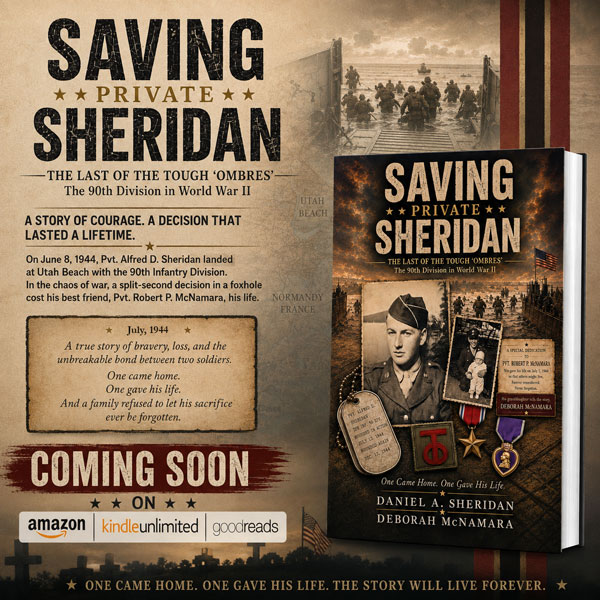
Click here view book trailer on YouTube.
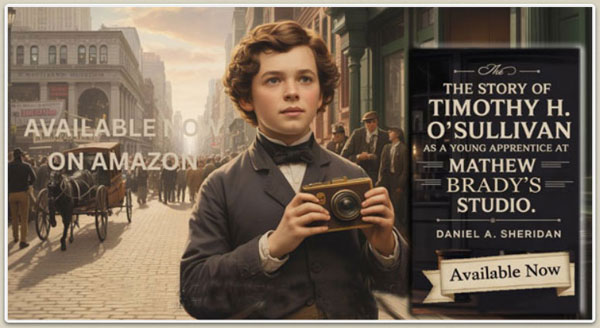
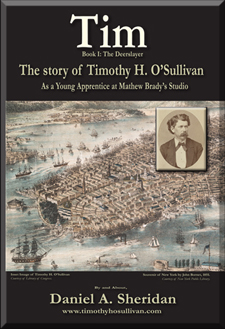
Tim — The Story of Timothy H. O'Sullivan
As a Young Apprentice at Mathew Brady's Studio
By Daniel A. Sheridan
Goodreads Reviews: ★★★★★
"Sheridan writes about photography the way poets write about love."
~ John Peter, Goodreads Reviewer
Regina Kate
There’s something enchanting about reading a book that feels painted rather than written. Tim is that kind of story. Every scene glows with light and shadow, like one of the daguerreotypes Sheridan describes. I could practically see the silver plates reflecting the city’s fog and faces. What stood out most to me was the tenderness with which Sheridan writes about mentorship and creativity. Brady is both genius and tyrant a man obsessed with capturing immortality. And Tim? He’s the perfect lens through which we see the world’s transformation. Beautifully told, meticulously detailed, and full of heart. I’ll be thinking about this one for a long time.
Jeffrey Shawn
I think what Sheridan accomplishes here is beyond storytelling, it’s preservation. He’s taken a largely forgotten figure, Timothy O’Sullivan, and given him a voice, a childhood, and a place in our imagination. The research is clear, but it’s never dry. What you feel instead is reverence for art, for craftsmanship, for those who dared to experiment before there were manuals or safety nets. The friendship-mentorship between Brady and Tim reminded me of relationships in my own life: stern guidance mixed with deep, unspoken respect. Every time Tim learned something new about light or time, I felt that same spark of wonder. By the end, I wasn’t just reading about photography I was seeing how passion and persistence shape who we become. A stunning, soulful work.
Margaret
The writing is so rich that I had to slow down just to savor certain passages. Sheridan’s New York is colorful and alive, equal parts wonder and danger. Absolutely engrossing.
Ava Bradford
Every word feels etched in silver. Sheridan’s writing is that precise, that luminous. Tim is one of those novels that feels slow in the best possible way it makes you linger, observe, notice light on faces and dust in the air. It reminded me why I fell in love with both photography and storytelling in the first place.
Sabine Traeder
What amazed me most about this book is its balance it’s sweeping in historical scope yet intimate in emotion. You see photography being born, but also a young boy learning about responsibility, creativity, and himself. Sheridan manages to make history feel deeply personal. That’s a rare gift.
Frank
Daniel A. Sheridan has crafted something far more ambitious than a simple historical novel. Tim is a genuine reconstruction of a moment in American history that we rarely see explored the messy, experimental, almost mystical birth of photography as an art form. Sheridan’s attention to detail is staggering. Whether he’s describing the texture of a daguerreotype plate or the feel of walking through pre–Civil War New York, every sensory cue feels authentic. But the true strength of the novel lies in Tim himself. His innocence, curiosity, and occasional fear give the book emotional grounding. Through Tim, we witness the awe of capturing an image for the first time an act that feels simultaneously scientific and magical. Sheridan’s portrayal of Mathew Brady adds another layer of depth, offering a portrait of a complicated artist whose genius borders on obsession. A stellar, meticulously researched, emotionally resonant story.
Elijah William
It’s astonishing that this is Sheridan’s first novel. The confidence, the rhythm, the emotional intelligence it feels like the work of someone who’s been writing for decades. Tim isn’t just a debut; it’s an arrival. It’s the kind of story that honors both history and the human heart.
Deborah
Few debut novels feel as assured as this one. Sheridan manages to intertwine the meticulous technical world of early photography with the emotional journey of a child forced into adulthood far too soon. The story excels in its layered structure: on the surface, it's about Tim’s apprenticeship; underneath, it’s about the birth of modern visual storytelling how images came to shape our understanding of war, identity, and memory. I found the scenes where Brady explains the “war over photography”French vs. English processes particularly fascinating. Sheridan uses these competing techniques as metaphors for choice, change, and progress. Tim, caught in the middle, becomes a stand-in for all young artists torn between tradition and innovation. Every chapter feels intentional. Every detail serves a purpose. By the end, I felt as if I had watched not only Tim grow, but an entire medium come to life. A rare, thoughtful, brilliantly crafted novel.
John Peter
Light that’s what this book is really about. How we see it, how we capture it, how it changes us. Sheridan writes about photography the way poets write about love. Each page feels illuminated by admiration for those who first learned to trap light on glass. Absolutely beautiful.
Roselia
This story reminded me why I love creative people — they see the world differently. Sheridan’s writing has that same visionary quality. You can feel his reverence for art, his empathy for Tim, and his fascination with how new technology changes us. It’s rare to find a book that feels both historical and modern in spirit. Tim is about invention, yes, but also about courage, the courage to imagine a world that doesn’t exist yet. Reading this felt like standing in front of an old photograph and realizing the people inside it once breathed, dreamed, and fought for beauty. That’s powerful storytelling.
Alfred
From the first page, it’s clear Sheridan knows what he’s writing about. His background as a photojournalist gives the story incredible depth. I loved how the book showed the clash between old and new ideas daguerreotype versus modern photography through the lens of a young boy’s ambition. Beautifully told.
Rachel Raph
This book completely surprised me. What starts as a simple tale about a boy’s apprenticeship becomes a journey into the soul of art itself. Sheridan paints 1850s New York with such texture the cobblestone streets, the smoky studios, the fragile hope of invention. Tim’s curiosity and courage reminded me how every artist begins: uncertain, but full of wonder. I finished the last page feeling inspired and oddly nostalgic, like I’d just stepped out of a photograph that came to life.
"I didn’t expect to cry at a story about daguerreotypes, but here we are. Loved it."
Melvin
This book made me feel like I was standing in that old studio, watching a picture form in the light. The mix of wonder and hardship in Tim’s story was just beautiful. Sheridan writes with a kind of quiet power that sneaks up on you. I didn’t expect to cry at a story about daguerreotypes, but here we are. Loved it.
Agnes Adams
What a gem! Sheridan combines adventure, mentorship, art, and history in one smooth narrative. Tim is an endearing protagonist, and his observations offer a unique window into a time period we rarely read about.
Readers Judy
Elegant, atmospheric, and surprisingly funny in moments. The transitions between Tim’s youthful curiosity and the enormous historical weight around him are handled with such grace. I adored this.
Friedrich Claus
There are novels that inform, and then there are novels that illuminate. Tim belongs to the second kind. Sheridan doesn’t just show us the dawn of photography he shows us what it means to chase light when the world around you is still learning to see it.  Through young Tim’s eyes, the dusty streets of 1850s New York become a stage for invention and self-discovery. The relationship between Brady and Tim fascinated me; it’s part mentorship, part quiet battle between old vision and new possibility. Sheridan’s writing is patient and rhythmic each scene unfolds like an exposure coming to life. By the end, I felt I understood something about courage, not just art: the courage to look closely, to hold on to what others overlook, and to make something lasting out of it.
Click here to read Tim book reviews on GoodReads.com


 Click here